

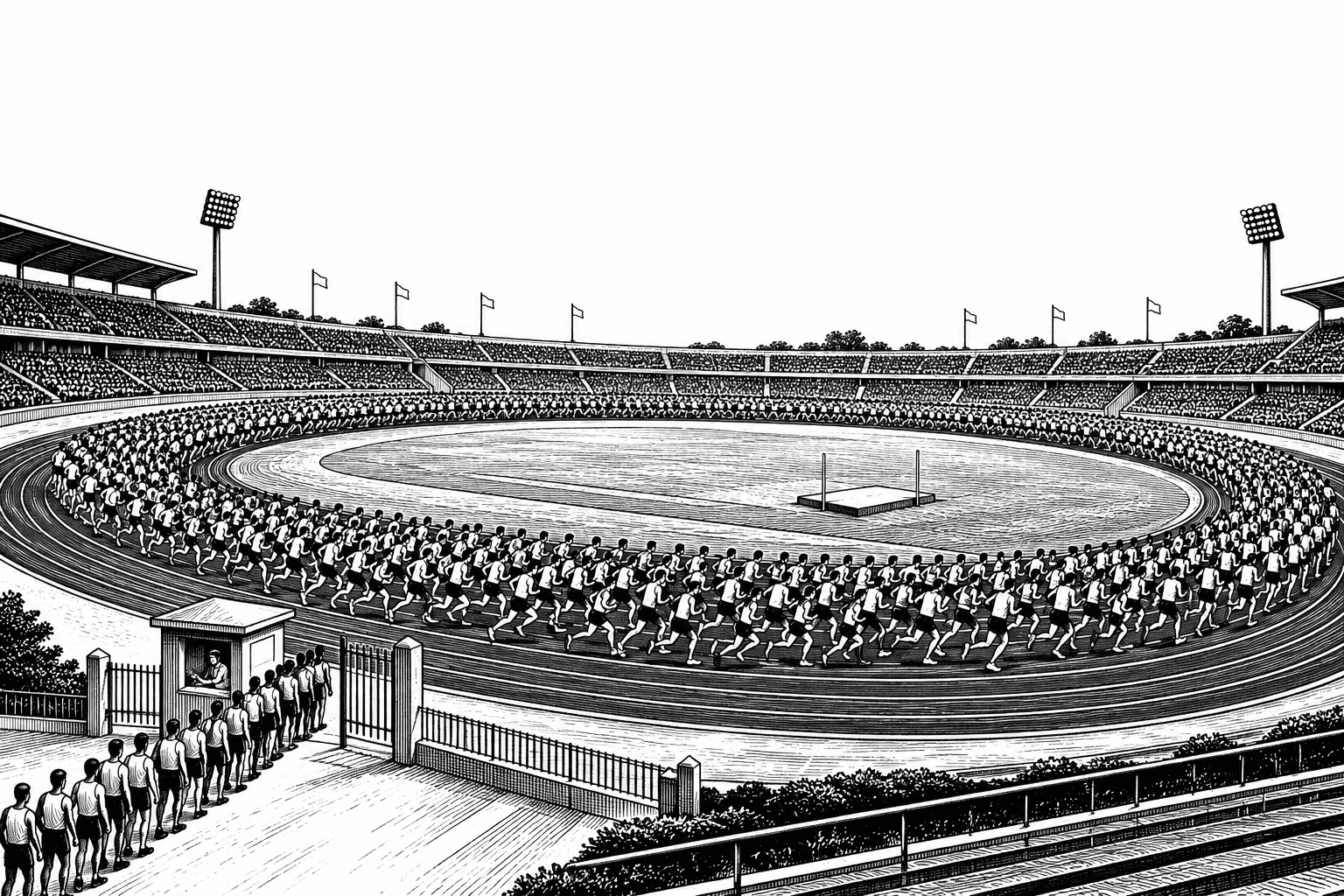
The biggest companies don't win the race. They sell it.
Bottom line
A multipolar trap is a situation where a move that's smart for one person becomes bad for everyone once they all make it, and nobody can fix it by stopping on their own. One driver takes the back road around a traffic jam and saves ten minutes. A thousand drivers take it, and the back road becomes the jam. Every driver made the smart choice. Every driver ended up worse off.
Companies fall into these traps all the time. They find a shortcut, or someone shows it to them, or they copy someone who's already on it. They take it, and they do well until everyone else takes it too. Then the margins disappear and most of them fail. The biggest winners are the ones that live above the trap: they convince everyone else to run, sell the entry ticket, write the rules, and take a cut of every lap. Shopify did this with dropshipping. The AI labs are doing it right now with "anyone can build software."
I wanted to do a deep dive on this and share my perspective on how it plays out, who ends up on which side, and what that means if you're the one writing the checks.
Why I'm writing this
This post is me putting my thoughts together after hundreds of conversations with entrepreneurs, VCs, and operators. Their stories of what worked and what didn't. The mistakes they made, what they would have done differently, and the lessons they took away. The same pattern kept showing up in those stories, and it maps onto an idea I've carried around for years: the multipolar trap.
The way I think about it, there are two ways past a multipolar trap. The first is to end it: a monopoly, a regulator, or a fixed set of rules that stops the race. The second is to exploit it. If you know a system is stuck in a multipolar trap, you can predict how everyone inside it will act. Startups and venture capitalists hunt for these traps because that's where "disruption" comes from: someone steps in and becomes the new authority that sets the rules.
In the stories I kept hearing, the companies that succeeded were the ones that did one of those two things. They either broke the trap or exploited it. The ones that failed were the ones that stayed inside it and ran harder.
That second path is what this post is about. I'd been meaning to write it for a while. Reading Theo Baker's How to Rule the World, this year's New York Times bestseller about power at Stanford and in Silicon Valley, is what finally made me sit down and write it.
It comes down to a simple question: when everyone is told to compete, who actually wins?
The honest answer made me uncomfortable, because I'm one of the people competing. So this is partly a note to myself, and partly an argument I'd like someone to poke holes in.
A closer look at the trap
Another way to say it: a multipolar trap is a race where everyone would be better off if nobody ran, but nobody can afford to be the one who stops.
Think about a concert. One person stands up and gets a better view. Then everyone stands up, and nobody's view is better than it was. Everyone is just tired. And you can't sit back down, because then you see nothing at all.
That's the whole idea. A move that helps one person hurts everyone once they all copy it, and once they've all copied it, no one can undo it alone. Arms races work like this. Overfishing works like this. Two coffee shops on the same street cutting prices until neither makes money works like this. Trading markets work like this too. If one person decides to sell, they get out fine. If everyone decides to sell at once, there's nobody left to buy, and the price collapses under all of them. Every seller made the smart move, and the smart move is what wiped them out. The back road around the traffic jam is the small everyday version.
Here's the detail that changed how I see it: in a normal multipolar trap, nobody wins. The effort everyone burns just disappears.
What I noticed is that the biggest companies found a way to win these traps. Not by running faster, but by owning the road. They'd rather own the slot machines than play them.
The old advice is to sell shovels during a gold rush. But there's a more powerful version: sell the shovels and help sell the dream of finding gold.
The pattern has four parts. Make participation feel possible. Charge for the tools or access needed to participate. Control some important part of the terms, whether that's pricing, distribution, an auction, or an API. Then earn more as activity grows, even when the average participant finds it harder to make money.
The invitation doesn't have to come from an advertisement. It can come from a founder on a podcast, a success story on social media, or a friend whose results make the whole thing look straightforward.
And the opportunity doesn't have to be fake. The tools can work exactly as promised. Some customers can build extraordinary businesses with them.
The mistake is confusing access with an advantage.
A tool that makes something easier for you may also make it easier for everyone who will compete with you. What looks like an edge at the beginning can become the minimum required to stay in the market.
In plain words: sell the race.
Example 1: Shopify and dropshipping
Bottom line: most dropshippers lost. Shopify grew six times over.
In 2015 a startup called Oberlo built a tool that let anyone import products from AliExpress into a Shopify store. In 2017, Shopify bought it. In 2019 it launched its first ad campaign, "Let's Make You a Business," and announced a million merchants. By the end of 2021 it had 2.06 million. Then it stopped publishing the number. Today's starter page says you could be selling by tomorrow.
The problem for dropshippers was never the tools. It was that everyone had the same tools: the same AliExpress supplier, the same Facebook audience, the same ad. The first few thousand made real money. Then the back road filled up. Meta's average ad price rose 47% in a single year, because every dropshipper was bidding for the same eyeballs.
Someone counted how it ended. An analysis of more than five million Shopify stores found that only about a third survived a year. A store opened in 2021 lasted a median of 143 days.
And Shopify? Sales through its platform went from $61 billion in 2019 to $378 billion in 2025, and grew another 32% last quarter. It shut Oberlo down in 2022 and called it a "routine occurrence." The on-ramp was disposable. The road wasn't.
I got two things wrong when I first thought about this. I thought Shopify was the only winner. It wasn't. Meta sold the ads and AliExpress sold the goods, so dropshippers had three landlords. And I thought Shopify's 85% stock crash in 2022 meant the model broke. It didn't. Revenue grew every single year through the crash. Merchants dying isn't a bug in the model. It's the exhaust.
Shopify's president said the quiet part on the last earnings call: "whether stores are built by people or AI, Shopify runs underneath it all."
Example 2: AI labs and "anyone can build"
Bottom line: the labs are selling a race to builders like me. And the labs are runners in a race Nvidia sells.
The ads are the same ads Shopify ran, with new words. OpenAI's Super Bowl commercial this year is literally titled "You Can Just Build Things." Lovable's first campaign: "If the idea won't leave you alone, build it," and by June it was hosting a million new projects a week. Sam Altman has a betting pool with his CEO friends on the year the first one-person billion-dollar company appears.
It's working. Americans filed a record 5.6 million new business applications in 2025. In the first half of this year, vertical AI apps were 63% of AI deals and 13% of the money.
Here's what happens to the runners, in two cases I've watched up close.
If you win, you're a customer. Cursor won the AI coding race. Its prize: in 2025, Cursor and GitHub Copilot were about a quarter of Anthropic's revenue, while Cursor lost money on every individual developer and competed with Claude Code, a product its own supplier built.
And win or lose, the lab learns from you for free. When Anthropic noticed non-engineers using Claude Code, its team built Cowork in about a week and a half. Cowork's plugins took $285 billion off software stocks in one day this February. Altman told founders in 2024, about startups built as if the models won't improve: "we're going to steamroll you."
The simplest way to see the whole stack is gross margin, because margin tells you how many companies share a layer. The fastest-growing AI apps run at around 25%, and some are negative. The labs sit in the middle: Anthropic reportedly cut its 2025 margin forecast to 40%. Nvidia runs at 75%, and it is the most valuable company on earth.
Every layer sells the race to the layer below it and pays rent to the layer above. The money pools at the top, where there's only one of each.
What I'd look for, if I were picking
Bottom line: ask every pitch one question. Whose race is this company in, and whose race does it sell?
This part matters most for funds that need one company to pay back the whole fund, not a tidy 3 to 5x. A company that can only answer the first half of that question is a runner. It might be a great runner. But the money it makes is being collected one layer up, by a company you probably can't buy at a price that works.
There are two ways to sell a race. The first is to organize a race that already exists. Google didn't invent advertisers competing for attention, and it didn't end the competition either. It turned the chaos into an auction and kept the difference. Per testimony in the DOJ trial, it also tuned that auction to raise prices about 5% "to meet our quota." The question to ask here is who's losing a race right now and would pay for order.
The second is to start a new race. Shopify, Uber, Lovable. Recruit the runners, sell the tickets, own the rules. The question to ask here is what a million people will be told they can do next.