

In my junior year, I spent quite a lot of time talking to people who work at venture capital firms. It started as a class assignment. We were taking an entrepreneurship course on product-market fit, and the task was straightforward: pick a subset of potential customers, go interview them, and figure out what problems they actually have. Most of my classmates picked small business owners or startup founders. I picked VCs.
I had always found the venture capital world fascinating. Think about it for a second. Your entire job is to have the brightest minds in the world come to you and share the single best idea they have ever had. You get to hear about technologies that don't exist yet, markets that are just forming, and founders who are willing to bet everything on a vision. Who wouldn't find that compelling?
So I started setting up coffee chats. A lot of them. I talked to analysts and associates at early-stage funds, principals at growth-stage firms, and general partners and managing directors at some of the most established names in the industry. I expected to learn about deal sourcing strategies and portfolio construction. Instead, I stumbled into something I did not expect at all.
What I Found Over Coffee
A pattern emerged across every single conversation. When I asked "what do you love about your job?", the answer was always some version of the same thing: meeting people. Hearing ideas. Backing founders they believe in. The human side of venture capital. That's what gets them out of bed in the morning.
But when I flipped the question and asked "what do you wish you could change?", the answers were also remarkably consistent. The paperwork. The data entry. The endless portfolio updates, LP reports, and deal tracking spreadsheets. The mundane operational tasks that consume hours every week and pull them away from the work that actually matters.
Every VC I spoke with, from the most junior analyst to the most senior managing director, was spending a staggering amount of time on tasks that had nothing to do with finding and backing great companies. The frustration was palpable, and the irony was hard to ignore.
The Irony Was Hard to Ignore
VC firms are supposed to be among the leanest companies in the world. A fund managing hundreds of millions of dollars might have a team of five or six people. When you are that lean, every hour of operational overhead is an hour stolen from sourcing the next great deal. There is no back office to absorb the busywork. The partners, the associates, the analysts, they are all doing it themselves.
And here is the deeper irony. These are the same people investing billions of dollars into AI and automation startups. They sit in pitch meetings every single day listening to founders explain how artificial intelligence will transform entire industries. Yet their own workflows still run on spreadsheets, email chains, and manual data entry. If any industry should be the first to adopt the technology it funds, it should be venture capital. It would be pretty hypocritical to refuse to adapt to the very thing you are betting on.
So I Built VCOS
VCOS is an AI-first operating system for the entire venture capital lifecycle. The mission is simple: automate every workflow that keeps investors from doing what they do best. Not replace the human judgment that makes great investors great, but eliminate the operational friction that buries it under hours of administrative work.
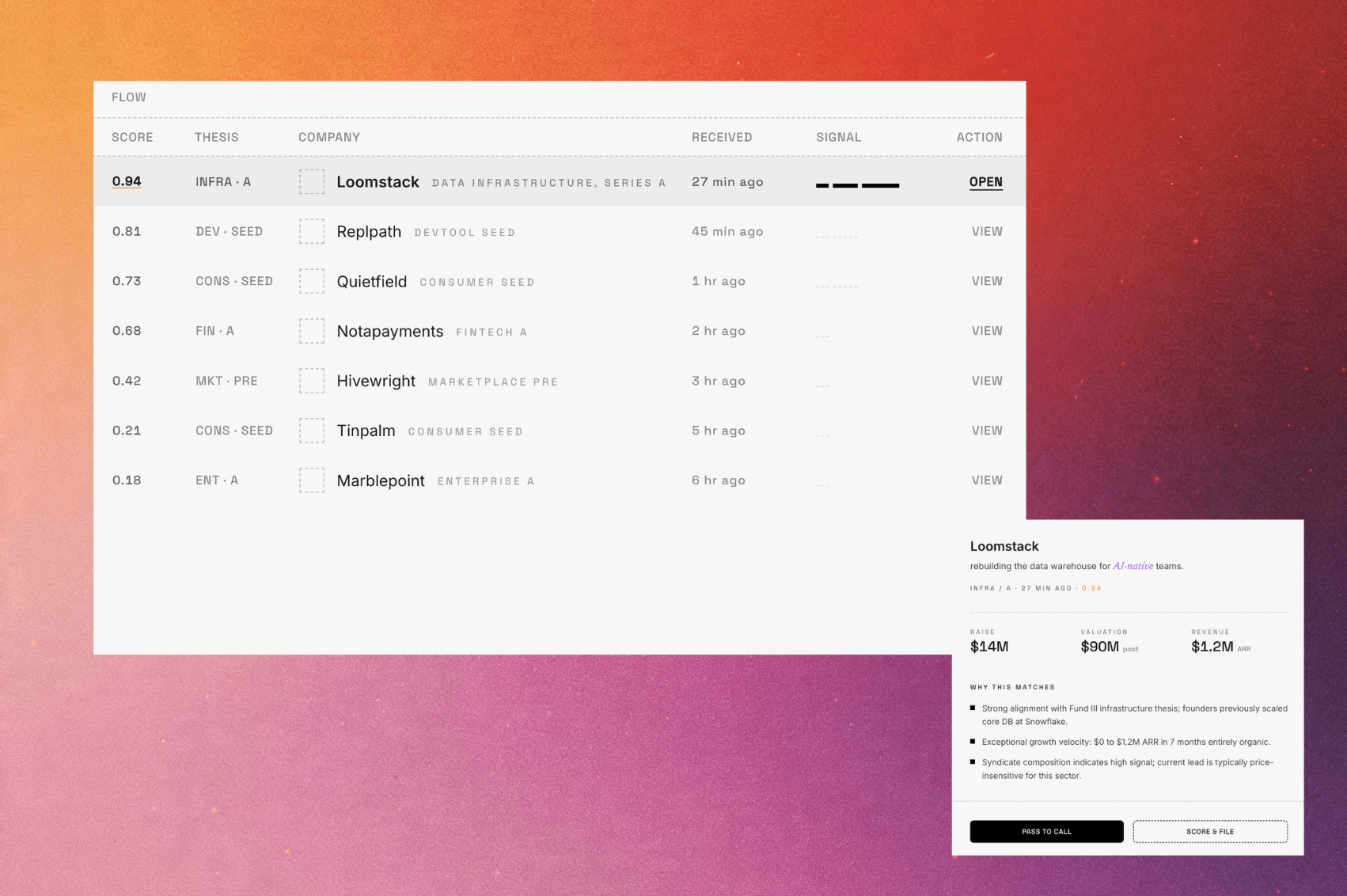
The platform is built as a suite of integrated tools, each designed to tackle a specific part of the VC workflow. Flow handles deal management, from instant pitch screening against your investment thesis and structured deal tracking to AI-powered deal scoring and one-click document generation. Clarity automates due diligence workflows, making sure critical insights are never overlooked. Pulse streamlines fund administration and compliance. Vista gives you instant visibility into your portfolio and simplifies LP reporting. And a growing set of Tools fills in the gaps across daily operational work that quietly adds up.
Why This Matters
Venture capital shapes which ideas get funded and which technologies reach the world. When VCs spend less time on overhead and more time evaluating companies, better decisions get made. Better companies get funded. The ripple effects matter far beyond any single fund or portfolio.
This is not just a product. It is a thesis: that the firms shaping the future of technology should also be the first to embrace it in their own operations.
What started as a class assignment and a series of coffee chats turned into something real. If you work in venture capital and any of this resonates, or if you are just curious about what an AI-first fund looks like in practice, I would love to hear from you.