

Walk into any large office building today and someone will tell you it is smart. There are sensors in the ceilings, meters on the electrical panels, air quality monitors tucked behind vents. The building knows how many people are on the fourth floor, how much CO2 is in the conference room, and exactly how many kilowatt-hours the HVAC system burned last Tuesday. Now go find the facility manager. They have fourteen browser tabs open, three different dashboards pulled up, and a spreadsheet they update by hand every Monday morning. That is what smart building management actually looks like for most operators today.
The data is not the problem. Buildings account for 42% of yearly CO2 emissions globally. Indoor CO2 concentrations above 1,000 ppm have been shown to cause a 50% decline in complex strategic thinking. The sensors capturing this information are already installed, from occupancy and air quality to energy consumption, thermal imaging, parking, and lighting. The raw signal is there. What is missing is anyone who can actually use it without a degree in dashboard archaeology.
I joined Grydsense to help solve this. Grydsense builds an AI-powered platform that transforms how buildings are understood and managed, combining IoT sensors, machine learning, and cloud analytics into a single system. My job was to make all of that sensor data genuinely accessible. Not through another dashboard. Through conversation.
The Dashboard Graveyard
Here is the thing about building management software. Most of it was designed by engineers, for engineers. You get an occupancy dashboard over here, an HVAC dashboard over there, a separate portal for energy metering, another one for parking, and maybe a lighting control system with its own login. None of them talk to each other. The people who are supposed to use them, facility managers, corporate real estate teams, sustainability officers, end up spending more time navigating interfaces than actually making decisions.
Think about a corporate real estate team managing a university campus with thirty buildings. Someone asks a reasonable question: which floors are consistently underutilized on Fridays? To answer that, you need to pull occupancy data from one system, cross-reference it with space booking data from another, export both as CSVs, and manually stitch them together. By the time you have the answer, it is already the following Friday. So most of the time, nobody bothers. Buildings keep heating empty floors. People keep working in rooms where the CO2 is high enough to dull their thinking. And operators keep making decisions based on gut feeling because the data, while technically available, is practically unreachable.
What If You Could Just Ask?
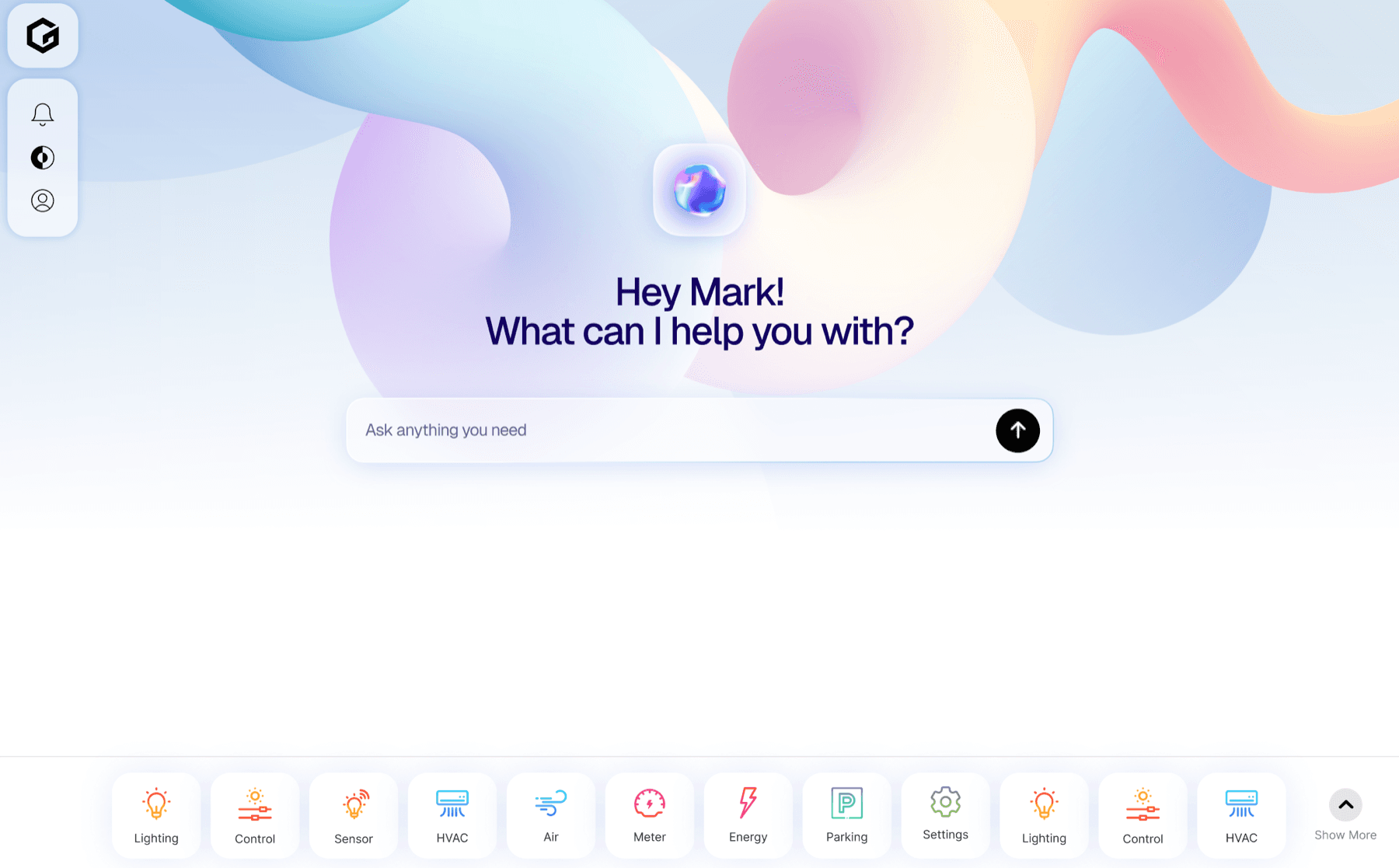
That is the premise behind GrydAI. Instead of logging into dashboards, building managers ask questions in plain English. "What was the average occupancy of the third floor last month?" "Which zones had CO2 levels above 800 ppm this week?" "How does Building A's energy consumption compare to Building B?" GrydAI is an AI agent built on top of Grydsense's unified data platform. It comprehends building management data across every domain, from occupancy and air quality to energy consumption, space utilization, parking, lighting, and thermal imaging. It returns answers instantly.
The shift here is not just about convenience. It is about who gets to access insights. Before, you needed to know which dashboard to open, which filters to apply, and how to interpret the output. That meant building intelligence was locked behind a skill barrier. With GrydAI, anyone from the facility manager to the CFO can ask a question and get a clear, plain language answer. No training required. No CSV exports. No waiting until next Friday. The question gets asked, and the building answers.
Now Give Every AI Agent a Building IQ
Building GrydAI was the first step. But we realized something important. The real power is not in a single chatbot. It is in making building data accessible to every AI tool. That is why we built GrydAI MCP, an open Model Context Protocol connector that gives any large language model instant context into a building's operational data.
MCP is a standard that lets AI tools plug into external data sources. With GrydAI MCP, you can connect ChatGPT, Claude, Cursor, or any MCP-compatible tool directly to Grydsense's platform. Suddenly, use cases multiply. An architect uses Claude to analyze space utilization patterns while designing a renovation. A sustainability consultant asks ChatGPT to draft an energy audit report using real consumption data from the past quarter. An operations team sets up an AI agent that generates weekly building performance summaries automatically, no human in the loop.
The connector is open by design. We did not want to build a walled garden where Grydsense data only lives inside Grydsense tools. The goal is the opposite: let building intelligence flow into whatever workflow people are already using. If your team runs on Claude, your building data should be there too. If your sustainability reporting lives in a custom pipeline, your sensor data should plug right in.
Buildings Should Not Need Interpreters
Buildings are the single largest category of CO2 emissions on the planet. Making them more efficient is not a nice-to-have. It is existential. But efficiency requires understanding, and understanding requires data that people can actually use. The interface to building data should not be dashboards that require weeks of training to read. It should be language. Ask a question, get an answer. Whether you are a facility manager checking air quality, a sustainability officer preparing a compliance report, or an AI agent running an automated workflow.
That is what we built at Grydsense. GrydAI gives buildings a voice. GrydAI MCP gives every AI tool the ears to listen. If you work in building operations, corporate real estate, or sustainability and any of this resonates, I would love to hear from you.